


You work hard. You train harder. But if you’re not feeding your muscles the right way after training, you’re leaving real gains on the table. The role of protein in recovery is not just about slamming a shake after your last set. It’s about understanding what your body actually needs to rebuild muscle tissue, reduce soreness, and come back stronger. This guide cuts through the noise, challenges the myths you’ve probably heard, and gives you the exact evidence-based strategies to make your recovery as savage as your training.
Table of Contents
- Key takeaways
- The role of protein in muscle recovery and repair
- How much protein you actually need for recovery
- Protein quality and the best sources for recovery
- Protein for older athletes and high-volume trainers
- Practical ways to hit your protein targets every day
- My honest take on protein and recovery
- Fuel your recovery with Savageaf
- FAQ
Key takeaways
| Point | Details |
|---|---|
| Protein drives muscle repair | Your muscles break down during training and need amino acids to rebuild stronger every session. |
| Daily intake beats perfect timing | Hitting 1.6 to 2.2 g/kg body weight consistently matters more than obsessing over a 30-minute window. |
| 20 to 40 grams per meal is the sweet spot | Spreading protein across 3 to 5 meals daily maximizes muscle protein synthesis throughout the day. |
| Leucine is the trigger | Choose leucine-rich proteins like whey and eggs to activate the muscle repair process effectively. |
| Pair protein with carbs post-workout | A 2:1 carb to protein ratio speeds amino acid uptake and restores your energy stores faster. |
The role of protein in muscle recovery and repair
Every time you push through a heavy squat session or finish a brutal sprint workout, you create microscopic tears in your muscle fibers. That is not a bad thing. That is how you get stronger. But those tears only heal and grow back thicker if your body has the raw materials to do the job. Protein is those raw materials.
Here is what happens at the cellular level. Your body breaks dietary protein down into amino acids, which then flood your bloodstream and get shuttled to damaged muscle tissue. This process is called muscle protein synthesis (MPS). Think of it as your body’s construction crew showing up at the job site. Without enough amino acids on deck, the crew sits idle. Nothing gets built.
The amino acids that matter most are the essential ones, the nine your body cannot produce on its own. Among those, leucine is the foreman. Leucine directly triggers the molecular signaling pathway that kicks off MPS. Without enough leucine, protein synthesis simply does not fire at full capacity, no matter how much total protein you eat.
Protein does more than rebuild muscle, too. It supports immune function, helps repair connective tissue like tendons and ligaments, and keeps your hormonal balance in check. Without adequate protein, the body struggles to repair tissues, leaving you chronically sore, fatigued, and more vulnerable to injury. That is a slow death for any athlete’s progress.
Key roles protein plays in recovery:
- Rebuilds damaged muscle fibers after training stress
- Provides leucine and essential amino acids to activate muscle protein synthesis
- Supports tendon, ligament, and connective tissue repair
- Maintains immune system function during high training loads
- Regulates hormones tied to muscle growth and stress response
Pro Tip: If you’re consistently sore for more than 72 hours after training, low protein intake is often the first thing to investigate before blaming your program or sleep habits.
How much protein you actually need for recovery
This is where most people get it wrong, either dramatically undereating protein or obsessing over timing to a paranoid degree. Let’s talk numbers first.
Daily protein intake of 1.6 to 2.2 grams per kg of body weight is the proven range for active individuals focused on muscle recovery and growth. For a 150-pound person, that lands around 110 to 150 grams per day. For a 200-pound athlete training hard five or six days a week, you’re looking at 145 to 200 grams daily.
Now here is the key thing most people miss about per-meal distribution. Consuming 20 to 40 grams per meal spread across three to five feedings daily is the most effective protocol for keeping muscle protein synthesis elevated. Eating 100 grams of protein in one sitting does not give you extra credit. Your body taps out at around 40 grams for any meaningful MPS response per feeding. The rest gets used for energy or excreted.
Here is a practical framework for hitting your numbers:
- Calculate your target. Multiply your body weight in kilograms by 1.8 as a solid middle-ground starting point.
- Divide across four meals. Aim for 25 to 40 grams per sitting depending on your size and total daily target.
- Time at least one dose post-workout. Consuming protein within 1 to 2 hours after exercise reduces soreness and accelerates repair.
- Include a protein-rich snack before bed. Casein or cottage cheese overnight supports muscle repair during sleep.
- Track for two weeks. Most people discover they are hitting only 60 to 70 percent of their actual target.
The infamous “30-minute anabolic window” is largely a myth for most people. Muscle protein synthesis stays elevated for up to 24 to 48 hours after training, though it peaks in the first few hours. So a post-workout shake is still a smart move. Just do not panic if you eat 90 minutes after your session instead of 15.
Stat check: For a 68 kg (150 lb) individual, the daily protein target for optimal recovery sits between 110 and 150 grams. Most active people eating a typical American diet get around 70 to 80 grams. That gap is costing them recovery.
Protein quality and the best sources for recovery
Not all protein is built equal. The difference between a chicken breast and a handful of almonds is not just the grams on the label. It is the amino acid profile, the leucine content, and how fast your body can actually use it.

Complete vs. incomplete proteins
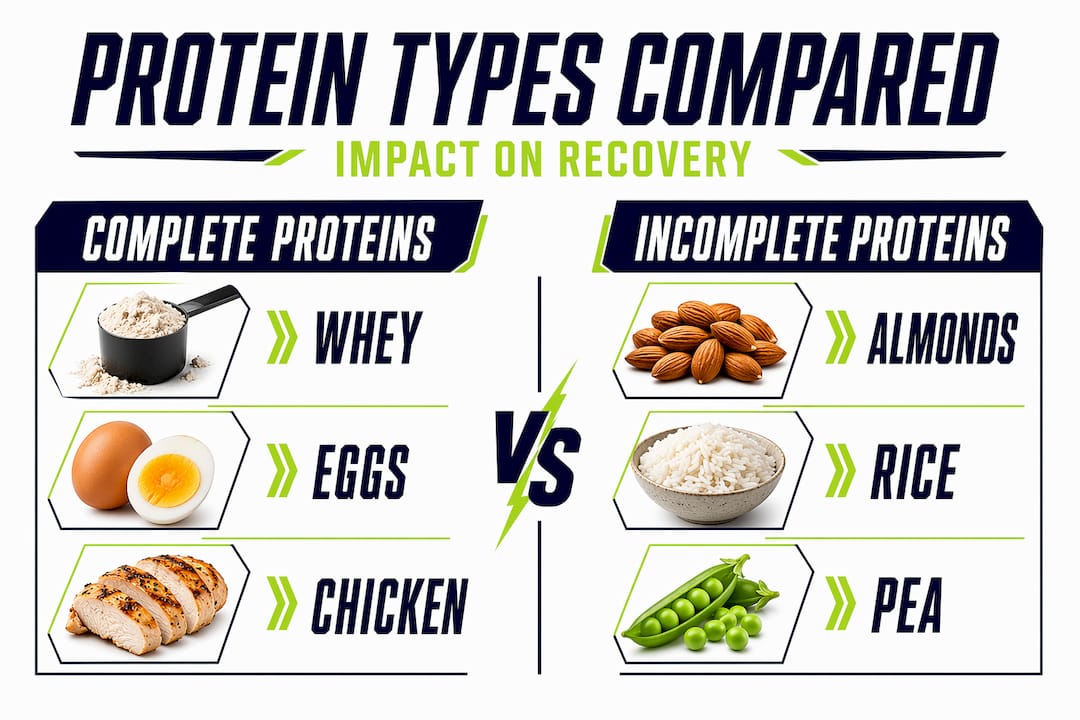
Complete proteins contain all nine essential amino acids in adequate amounts. Animal sources like whey, eggs, chicken, beef, and fish all qualify. So do certain plant sources like quinoa and soy. Incomplete proteins, like most grains, legumes, and nuts, are missing one or more essential amino acids. You can still build a complete amino acid profile with plants, but you need to combine sources strategically throughout the day.
| Protein Source | Complete? | Leucine Content | Best Use Case |
|---|---|---|---|
| Whey protein isolate | Yes | Very high | Post-workout, fast absorption |
| Eggs | Yes | High | Any meal, versatile |
| Chicken breast | Yes | High | Main meals |
| Quinoa | Yes | Moderate | Plant-based athletes |
| Soy protein | Yes | Moderate | Plant-based post-workout |
| Rice + pea protein blend | Combined | Moderate | Vegan supplement option |
| Lentils | No | Low | Combine with grains |
Whey protein stands out because it is leucine-rich and fast digesting, making it the gold standard for post-workout recovery. It gets to your muscles fast when the demand is highest.
Post-workout, pair your protein with fast-digesting carbs. A 2:1 carb to protein ratio boosts insulin response, which drives amino acids into muscle tissue more efficiently and restores glycogen at the same time. Think a protein shake with a banana, or a bowl of rice with chicken.
Pro Tip: If you are using plant-based protein powders, look for blends that combine rice and pea protein. Together they create a near-complete amino acid profile that rivals whey in recovery effectiveness.
Protein for older athletes and high-volume trainers
If you are training hard and over 40, or if you are running high-volume blocks with multiple sessions per week, the standard protein advice may not cut it for you.
Older adults experience something called anabolic resistance. Aging muscles require higher leucine-rich doses post-exercise because the muscle protein synthesis response to a given amount of protein becomes blunted. In practical terms, where a 25-year-old might trigger full MPS with 25 grams of whey post-workout, a 50-year-old may need 35 to 40 grams to get the same signal firing.
For this group, strategic nutrition adjustments including leucine-rich foods and distributed protein feedings throughout the day are the most effective tools for maintaining and building muscle. This is not optional maintenance mode. It is performance preservation.
Key adaptations for masters athletes and high-frequency trainers:
- Bump daily intake toward the upper range at 2.0 to 2.4 g/kg body weight during intense training blocks
- Prioritize leucine-dense sources like whey, eggs, and salmon at every main meal
- Never skip the post-training protein window. The anabolic response is more time-sensitive as you age
- Consider adding a leucine supplement or higher-leucine protein powder if anabolic resistance is a real concern
- Spread protein across five or even six smaller feedings rather than three large ones to maximize absorption at each sitting
High-volume athletes in general also face elevated tissue breakdown demands. A two-a-day athlete or someone deep in marathon training is breaking down significantly more protein than a three-day-a-week gym goer. Your intake needs to scale with your output.
Practical ways to hit your protein targets every day
Knowing the science is step one. Actually executing it six days a week under real-life pressure is the whole game. Here is how to make consistent protein intake non-negotiable.
- Build your meals around protein first. Before deciding on carbs or fats, choose your protein source. Everything else fills the plate around it.
- Prep in batches. Cook a pound of ground beef, a batch of hard-boiled eggs, or a sheet pan of chicken every two to three days. Prep kills the excuse.
- Keep a post-workout protein source on deck. A shaker bottle in your gym bag with a scoop of whey protein isolate pre-loaded means zero friction between training and recovery.
- Use liquid protein when appetite tanks. Liquid protein sources deliver amino acids fast and are easier to get down when solid food sounds miserable after an intense workout.
- Track your intake for at least two weeks. Use any food logging app. Most people are shocked at how far below their target they have been operating.
If your appetite completely shuts down post-training, that is normal for hard sessions. A shake is your best friend here. Solid food can wait 45 to 60 minutes. Your muscles cannot. You can also explore protein supplementation options to match your specific goals and training style.
Pro Tip: Add Greek yogurt or cottage cheese as a before-bed protein hit. Both are naturally high in casein, a slow-digesting protein that feeds your muscles through the night and significantly improves morning recovery.
My honest take on protein and recovery
I’ve worked with enough gym warriors and competitive athletes to say this with complete confidence: the number one recovery mistake is not bad timing. It’s chronically under-eating protein and not even knowing it.
I’ve seen people obsess over taking a shake within 20 minutes of their last rep while consistently eating 90 grams of protein a day on a 200-pound frame. They wonder why they are always sore, always tired, always stalled. The answer is not their program. It’s the gap between what they think they are eating and what they are actually eating.
My take on protein timing consistency is this: nail your daily total first. Get your grams in every single day, spread it out intelligently, and make sure your sources are high quality and leucine-rich. Once that is dialed in consistently, then start optimizing timing.
Quality beats quantity myths, too. I’ve seen people chase the highest gram count with cheap sources and wonder why recovery is still subpar. Thirty grams of whey isolate will do more for your muscle repair than 50 grams of a low-quality blend with a poor amino acid profile.
Tailor your intake to your body, your training load, and your age. There is no one-size-fits-all. But there is a non-negotiable truth: if protein is low, recovery suffers. Full stop.
— Ronnie Savoie
Fuel your recovery with Savageaf
You do not train like everyone else. Your recovery nutrition should not be average either. Savageaf built its protein lineup for athletes who demand quality in every scoop. Whether you want the fast-absorbing punch of a chocolate whey isolate post-workout or prefer a smooth vanilla option for morning meals, the products are engineered for real muscle repair, not just a pretty label.

Every Savageaf protein formula delivers leucine-rich, high-quality whey isolate with clean macros and a taste that does not make you dread your recovery window. Check out the full muscle growth and performance supplement collection and build your recovery stack around what actually works. No excuses. No shortcuts. Just fuel that matches your intensity.
FAQ
What is the role of protein in recovery after exercise?
Protein supplies amino acids that rebuild muscle fibers damaged during training, triggering muscle protein synthesis and accelerating tissue repair. Without adequate protein, soreness lasts longer and muscle growth stalls.
How much protein do I need post-workout?
Consuming 20 to 40 grams of high-quality, leucine-rich protein within one to two hours after exercise is the most effective dose for stimulating muscle protein synthesis and reducing soreness.
Does protein timing really matter for muscle recovery?
Timing has some benefit, but total daily protein intake consistency is far more important for most people. Aim for your full daily target spread across three to five meals before stressing about exact post-workout minutes.
What are the best protein sources for recovery?
Whey protein isolate, eggs, chicken, salmon, and Greek yogurt are top choices due to their complete amino acid profiles and high leucine content. Plant-based athletes should combine rice and pea protein or include quinoa and soy.
Do older athletes need more protein for recovery?
Yes. Aging muscles experience anabolic resistance, which means they require higher doses of leucine-rich protein to stimulate the same muscle protein synthesis response as younger athletes.


